
Delignitization constitutes one of the most decisive energy and development policy choices in Greece over recent decades. Embedded within the European framework for tackling climate change and achieving climate neutrality by 2050, the gradual withdrawal of lignite from the energy mix marks a profound structural transition. However, a critical question arises: does delignitization represent an opportunity or a threat for the Greek economy?
The answer is not straightforward. delignitization represents both a necessary environmental choice and a complex economic challenge. On the one hand, it creates the conditions for a sustainable and innovative productive transformation. On the other hand, it entails significant short-term socio-economic impacts, particularly in regions dependent on lignite activity, such as Western Macedonia and Megalopolis.
The Historical Role of Lignite in the Greek Economy
For more than fifty years, lignite has been the backbone of electricity generation in Greece. Its low extraction cost and domestic availability ensured energy security and relative price stability, contributing decisively to industrial development and overall economic growth.
At the same time, lignite regions developed around a one-dimensional production model. Thousands of jobs were created both directly and indirectly, while entire local economies became dependent on the operation of mines and power plants. Their contribution to the national economy was significant, albeit accompanied by a high environmental cost.
The Necessity of Delignitization
The gradual abandonment of lignite is not merely a national policy choice but an obligation arising from European and international commitments to reduce greenhouse gas emissions. The rising cost of CO₂ emission allowances, combined with the declining cost of renewable energy sources and stricter environmental requirements, renders lignite both economically and environmentally unsustainable.
Consequently, lignite phase-out is a necessary condition for the country’s energy transition. However, the speed and manner of its implementation will largely determine whether it functions as an opportunity or a threat.
Negative Socio-Economic Impacts
The most immediate consequence of delignitization is job loss. Thousands of workers in the energy sector and related activities face the risk of unemployment or the need for occupational transition. This impact extends beyond directly employed individuals, affecting a broad network of local businesses.
The decline in employment leads to reduced income and consumption, negatively affecting local economic activity. Gross Value Added in lignite regions shows a significant decrease, while per capita income declines noticeably.
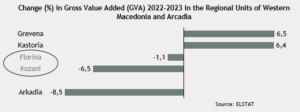
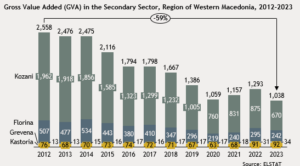
This development is primarily linked to the rapid contraction of the secondary sector as a result of Delignitization. Given that a substantial share of local production and income originated from lignite activity, regional economies become particularly vulnerable to the withdrawal of lignite units.
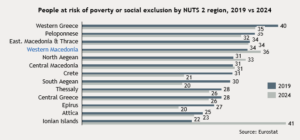
At the same time, rising unemployment—especially among young people—has led to further income reduction, reflected in increased poverty and social exclusion indicators.
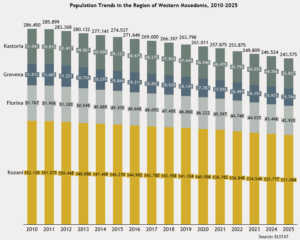
Another critical issue is demographic decline. The lack of employment opportunities leads to migration, particularly of young and skilled workers, to urban centers or abroad. This trend undermines the sustainability of local communities and limits their development prospects.
Overall, these developments create a vicious cycle of recession: job losses reduce demand, harm businesses, and discourage investment, leading to further economic contraction.
Delignitization as an Opportunity for Transformation
Despite its negative impacts, delignitization can also represent a significant opportunity for the Greek economy. The transition to a new energy and production model creates prospects for investment, innovation, and sustainable development.
The development of renewable energy sources constitutes a key pillar of this transition. Greece possesses significant solar and wind energy potential, which can be harnessed for clean energy production and job creation.
At the same time, the energy transition can act as a catalyst for the development of new sectors, such as energy storage, green industry, the circular economy, and digital technologies. Diversifying the production model is a fundamental prerequisite for the long-term sustainability of transition regions.
The utilization of former lignite areas for new uses, such as energy parks and agricultural activities, creates additional development opportunities. Moreover, strengthening innovation and entrepreneurship can contribute to the formation of a more resilient economic ecosystem.
Just Transition as a Necessary Condition
The concept of Just Transition is a central element in the discussion on delignitization. The transition to a low-emission economy cannot be successful unless it ensures social cohesion, the participation of local communities in policy design, recognition of the specific needs and contribution of affected regions, and a fair distribution of benefits and burdens.
In the Greek case, Just Transition is of particular importance, as the impacts of delignitization are geographically concentrated, especially in Western Macedonia and Megalopolis. Supporting lignite regions is not only a matter of social justice but also a prerequisite for the country’s overall economic development.
Government Policies
Recognizing the significant impacts of the transition on lignite regions, the Greek government has developed a multi-level policy framework aimed at mitigating negative effects and promoting a new sustainable development model.
A key instrument of this strategy is the Just Transition Development Programme (2021–2027) (https://eydam.gr/programm-dam-2021-2027), funded by European and national resources with a total budget of €1.63 billion. The programme is primarily implemented through the Just Transition Fund and aims to support affected regions by promoting investment, creating new jobs, and upgrading workforce skills.
Complementing this programme is the Special Development Programme for Just Transition (https://eydam.gr/programma_antistathmistikou_porou), integrated into the National Development Programme, which addresses immediate needs and funding gaps not covered by European funds, with particular emphasis on the most affected areas, such as Western Macedonia and Megalopolis.
In parallel, the Just Transition Development Programme (https://eydam.gr/sdam/) sets out the main directions for diversifying local economies, focusing on new productive activities such as renewable energy, agri-food, low-emission industry, sustainable tourism, and innovation. The goal is the gradual transition from a lignite-based model to a more diversified and resilient production system.
Additionally, a wide range of European financial instruments is utilized, including the ESPA 2021–2027 (https://www.espa.gr) and the Recovery and Resilience Plan “Greece 2.0” (https://greece20.gov.gr/), to fund projects in entrepreneurship, innovation, and green development. Simplified licensing procedures further enhance the investment attractiveness of these regions. Moreover, the Development Law (https://ependyseis.mindev.gov.gr/el/idiotikes) provides tax incentives and investment support, with higher aid intensity for transition areas.
In the field of employment, active labor market policies are implemented, including training programmes, subsidized employment, and support for the unemployed, aiming to facilitate the transition of workers from the lignite sector to new dynamic industries.
Challenges and Prospects
Despite the availability of significant policy tools, the transition continues to face serious challenges. Delays in investment implementation, bureaucracy, and the inability to create jobs immediately limit the effectiveness of these policies.
Nevertheless, the prospects remain positive. The successful implementation of the transition can lead to a more sustainable, resilient, and innovative economic model, while Greece has the potential to emerge as a regional hub for green energy, capitalizing on its comparative advantages.
The final outcome will largely depend on how the transition is managed. Through targeted policies, effective use of available resources, and active participation of local communities, delignitization can be transformed from a challenge into a driver of sustainable development.
Lignite regions should not be viewed merely as recipients of the transition’s impacts, but as potential protagonists of a new era, contributing to the shaping of a greener, more resilient, and more equitable economy.